Entrepreneur's Guide 2026 Edition

How to Start an eSIM Business

The eSIM market is projected to reach $16 billion by 2027. International travel is surging. Every smartphone in travelers' pockets supports eSIM. This is your complete guide to building a profitable eSIM business from scratch — with zero inventory, zero carrier agreements, and zero technical skills required.

$16B+ Market by 2027
150+ Countries
$0 Startup Cost
Start an eSIM business — eSIM Reseller Panel platform for entrepreneurs

The eSIM Business Opportunity in 2026

Three massive trends are converging to create one of the most compelling business opportunities in digital commerce: the explosion of international travel, the universal adoption of eSIM technology in smartphones, and travelers' deep frustration with expensive roaming charges and outdated physical SIM cards.

International travel has surged past pre-pandemic levels. The UNWTO reports that international tourist arrivals reached 1.4 billion in 2024 and continue to grow. Every one of those travelers needs mobile data connectivity abroad — and increasingly, they want it before they even board their flight.

eSIM-capable devices are now mainstream. Apple has been eSIM-only on iPhones since the iPhone 14 in the US market. Samsung, Google Pixel, and virtually all flagship Android devices support eSIM. The installed base of eSIM-compatible smartphones crosses billions of devices worldwide, and the number grows with every upgrade cycle.

Travelers hate roaming charges. International data roaming from traditional carriers costs $5-15 per megabyte in many markets. A single day of normal smartphone usage abroad can generate a $50-200 bill. eSIM data plans solve this problem elegantly — travelers buy a local data plan before departure, scan a QR code, and land with affordable connectivity already active.

The result: a massive, growing market with strong demand and a clear pain point that your business can solve. This guide shows you exactly how to build that business.

$16B+ eSIM Market by 2027
1.4B International Travelers/Year
25%+ eSIM Adoption Growth
0 Inventory Required

Why Start an eSIM Business?

Five market forces are making 2026 the ideal year to launch an eSIM business.

Travel Boom

International travel has fully recovered and is growing beyond pre-pandemic levels. Every traveler is a potential customer. The UNWTO projects continued growth through the decade, driven by pent-up demand, new airline routes, and the rise of digital nomadism.

📱

eSIM-Ready Devices

Apple iPhones, Samsung Galaxy, Google Pixel, and virtually all flagship smartphones now support eSIM. The installed base of eSIM-capable devices already numbers in the billions and grows with every upgrade cycle. Your addressable market expands automatically.

💰

Zero Inventory Model

Unlike any physical product business, eSIM reselling requires zero inventory. No SIM cards to stock, no packages to ship, no warehouse to manage. Every sale is a digital QR code delivered instantly by email. Your cost of fulfillment is effectively zero.

🌎

Global Addressable Market

Your customers are not limited to one city or country. Anyone traveling anywhere in the world is a potential buyer. With plans covering 150+ countries, you serve travelers from every origin to every destination — a truly global business from day one.

💻

Remote Work and Digital Nomads

The remote work revolution created a new class of perpetual travelers who need reliable data connectivity across multiple countries. Digital nomads are repeat customers who buy eSIM plans every time they move to a new destination — high lifetime value, low acquisition cost.

📈

Early Market Advantage

While eSIM adoption is growing fast, the reseller market is still relatively uncrowded compared to mature industries. Entrepreneurs who establish strong brands now will benefit from first-mover advantages as the market scales from $8 billion to $16 billion+ in the coming years.

eSIM Business Models Compared

There are three primary ways to enter the eSIM market. Here is how they compare — and why white label reselling is the smartest option for most entrepreneurs.

Factor Build Your Own Platform Affiliate Marketing White Label Reselling
Startup Cost $100,000 — $500,000+ $0 $0
Time to Launch 12 — 24 months 1 day 10 minutes
Brand Control Full None — you promote their brand Full — your brand everywhere
Pricing Control Full None — they set prices Full — you set retail prices
Profit Margins High (but offset by costs) Low — 10-30% commission High — 40-60%+ margins
Customer Ownership You own the relationship They own the customer You own the relationship
Carrier Agreements You negotiate individually Not needed Pre-negotiated, 150+ countries
Technical Maintenance Full-time team needed None Fully managed by provider
Business Asset Value High Low — no owned brand or customers High — branded, sellable business
Risk Level Very high Low Zero — pay-as-you-go

The verdict: White label reselling gives you the brand control and profit margins of building your own platform, combined with the zero-cost, zero-risk launch of affiliate marketing. It is the best of both worlds — and it is why the vast majority of new eSIM businesses in 2026 choose this model. For a deeper dive into white labeling, read our white label eSIM guide.

The Economics of eSIM Reselling

Understanding the numbers is essential. Here is how the economics work and what realistic revenue looks like at different scales.

How You Make Money

Your revenue model is simple: you buy eSIM data plans at wholesale prices from the platform and sell them to travelers at retail prices you control. The difference is your gross profit. Since there is no inventory, no shipping, and no fulfillment cost, your gross profit is nearly identical to your net profit.

Key advantages of the eSIM economics:

  • Zero inventory cost — No upfront purchase of SIM cards or data credits
  • Zero fulfillment cost — QR codes delivered automatically by email
  • No physical logistics — No warehouse, no shipping, no returns
  • Instant delivery — Customer pays, QR code arrives in seconds
  • Global sales — Sell to travelers anywhere, from anywhere

Revenue Projections

Average Retail Price $9.00
Average Wholesale Cost $5.00
Average Profit Per Sale $4.00
100 Sales/Month $400/mo
500 Sales/Month $2,000/mo
1,000 Sales/Month $4,000/mo
2,500 Sales/Month $10,000/mo
5,000 Sales/Month $20,000/mo

These projections assume an average $4 profit per sale, which is conservative for the eSIM market. Premium destinations (Japan, South Korea, European multi-country plans) often carry higher margins, and global plans for frequent travelers can yield $8-15+ in profit per sale. Your actual margins depend on your pricing strategy, target market, and plan mix. For detailed wholesale rates, see our pricing page.

Building Your eSIM Brand

Your brand is the most important long-term asset of your eSIM business. It determines how travelers perceive your service, whether they trust you with their connectivity abroad, and whether they come back for their next trip. Getting this right is worth investing real thought and effort.

Naming Your eSIM Business

Choose a name that is memorable, easy to spell, and conveys travel or connectivity. Avoid generic names that sound like every other eSIM provider. Strong names are short (2-3 words maximum), available as a .com domain, and work across languages if you are targeting international travelers.

Good naming patterns for eSIM businesses:

  • [Travel word] + [Tech word] — Combines the travel context with digital connectivity (e.g., "RoamLink," "TripConnect")
  • [Destination] + [Data word] — Emphasizes the global coverage angle (e.g., "GlobalSIM," "WorldData")
  • [Unique brand name] — Invented names that are distinctive and ownable (e.g., "Simterra," "Datafly")

Positioning and Target Markets

You cannot serve everyone equally well. Choose a primary target market and position your brand to speak directly to them:

  • Leisure travelers — The largest segment. Families, couples, and solo travelers visiting popular destinations. They value simplicity, reliability, and clear pricing. Position your brand as "the easiest way to stay connected abroad."
  • Digital nomads — High-value repeat customers who buy eSIMs frequently as they move between countries. They value global coverage, reliable speeds, and generous data allowances. Position as "connectivity for the location-independent lifestyle."
  • Business travelers — Corporate travelers who expense their connectivity costs. They value reliability, professional invoicing, and premium support. Position as "business-grade travel connectivity." Higher willingness to pay, but smaller market.
  • Group travel / tour operators — Travel agencies and tour companies need bulk eSIM solutions for their tour groups. Position as "eSIM solutions for travel businesses." Fewer customers but much higher volume per customer.

Visual Identity

Create a clean, professional visual identity that builds trust. Travelers are handing you money before their trip for a product they will rely on abroad — your brand needs to look credible. Invest in a proper logo (Canva, Fiverr, or a freelance designer), choose 2-3 brand colors, and maintain visual consistency across your storefront, emails, and social media.

Setting Up Your eSIM Business

From zero to a live, branded eSIM store in five straightforward steps using eSIM Reseller Panel.

1

Create Your Free Reseller Account

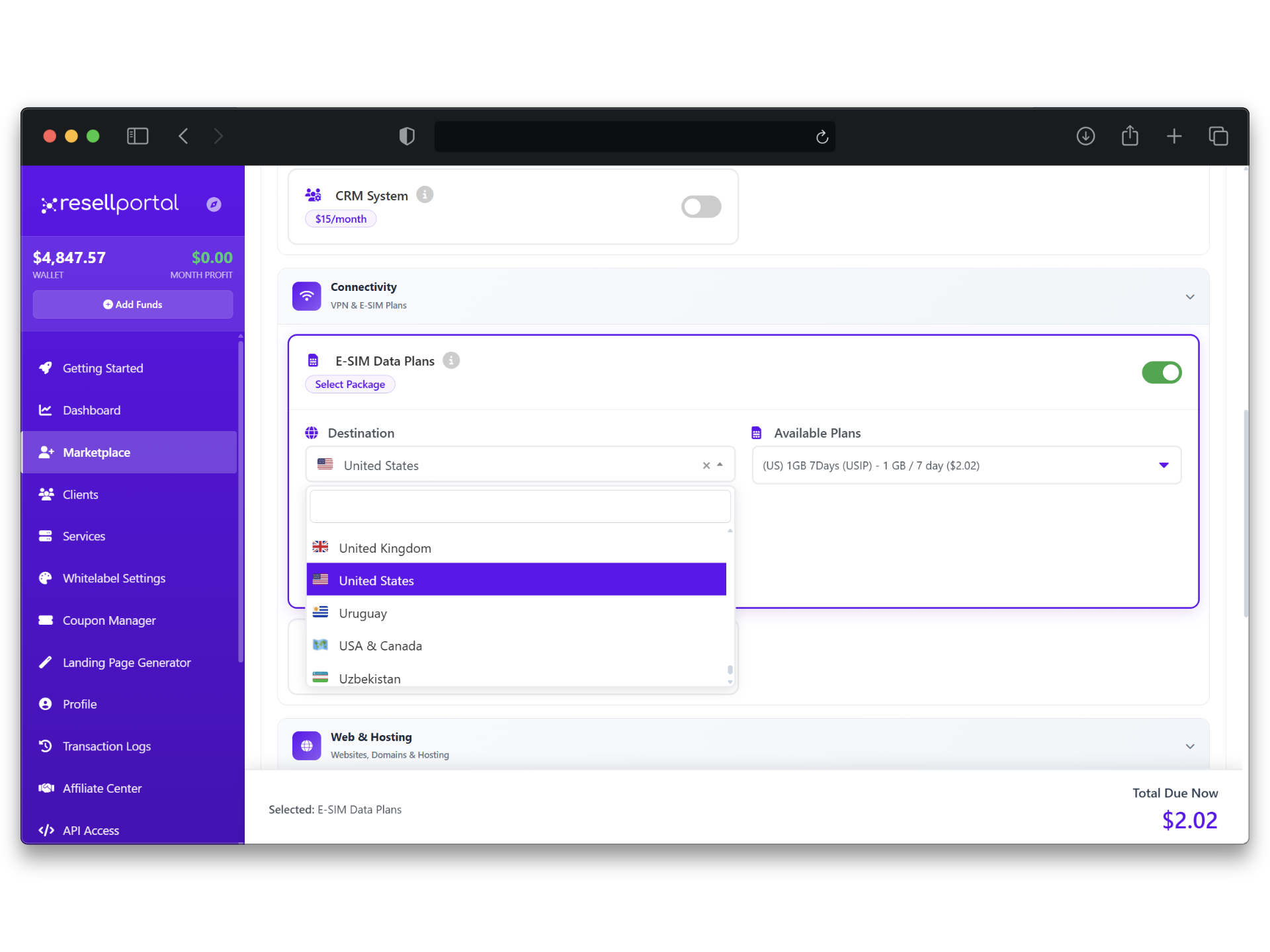
Sign up for a free eSIM Reseller Panel account. No credit card required, no approval wait, no trial expiration. Your account includes immediate access to the full catalog of eSIM data plans across 150+ countries. You only pay wholesale costs when customers make purchases.

2

Configure Your Branding

Upload your logo, set your brand name, choose your color scheme, and connect your custom domain. Every customer-facing element — storefront, QR delivery emails, customer dashboard — will display your brand identity. The underlying platform is completely invisible.

3

Set Your Retail Pricing

Review the wholesale prices for each plan and country, then set your retail prices to achieve your desired margin. You have complete control — charge more for premium destinations, offer competitive rates for high-volume markets, or create consistent markup across the board. Change prices anytime.

4

Connect Stripe for Payments

Link your own Stripe account so that customer payments deposit directly into your bank account. No middleman, no delayed payouts, no revenue sharing. Stripe handles credit cards, Apple Pay, and Google Pay in 135+ currencies. The integration takes under 5 minutes.

5

Launch and Start Selling

Your branded eSIM store is live. Share your storefront URL, embed purchase links on your website, or integrate via API. When travelers buy a data plan, payment is processed through Stripe, the eSIM QR code is generated automatically, and delivery email is sent instantly — all under your brand, all hands-free.

For a more detailed walkthrough of each step, read our how to resell eSIM guide.

Marketing Your eSIM Business

Building a great eSIM store is only half the equation. You need to put it in front of travelers who need connectivity. Here are the most effective marketing channels for eSIM businesses, ranked by long-term ROI.

1. Travel-Focused SEO Content

This is the single highest-ROI marketing channel for eSIM businesses. Create destination-specific content that ranks in Google when travelers search for connectivity solutions. Target keywords like "best eSIM for Japan," "Italy travel data plan," "eSIM vs SIM card Thailand," and "how to get internet in Europe."

Each piece of content should educate the reader about connectivity options in a specific destination and naturally recommend your eSIM plans as the solution. Publish 2-4 articles per week, and within 3-6 months you will have a library of content driving steady organic traffic from travelers in the planning phase — exactly when they are ready to buy.

2. Social Media and Community Building

Travel communities are everywhere: Reddit (r/travel, r/digitalnomad, r/solotravel), Facebook travel groups, Instagram travel accounts, and TikTok travel creators. Become a genuine, helpful presence in these communities. Share travel tips, answer connectivity questions, and build authority as the go-to resource for staying connected abroad. Avoid hard selling — provide value, and let your brand be the natural solution.

3. Travel Blogger and Influencer Partnerships

Partner with travel content creators who have engaged audiences. Offer them free eSIM plans to review, a commission on sales they drive, or a co-branded landing page. A single honest review from a trusted travel blogger can drive hundreds of sales. Focus on creators who provide practical travel advice rather than purely aspirational content — their audiences are more likely to actually be planning trips.

4. Travel Agency and Tour Operator Partnerships

Every travel agency and tour operator has customers who need data connectivity abroad. Approach them about adding your eSIM plans as a value-add to their booking flow. This can work as a referral arrangement (they get a commission) or a white-label integration (they sell your plans under their own brand). Either way, you tap into an existing customer base of confirmed travelers — the highest-intent audience possible.

5. Paid Advertising

Google Ads targeting "buy eSIM [country]" keywords capture travelers at the moment of purchase intent. Facebook and Instagram ads targeting travel interests build awareness. Start small ($10-20/day), measure your cost per acquisition, and scale what works. Paid ads accelerate growth but are most effective when combined with a strong brand and good organic presence.

Marketing priority for new eSIM businesses: Start with SEO content (free, compounds over time), then add social media presence (free, builds community), then explore partnerships (low cost, high leverage), and add paid ads last (requires budget, but fastest results). This sequence maximizes ROI at every stage of growth.
Scaling Your eSIM Business

How the growth journey typically unfolds — from launch to a thriving, profitable eSIM business.

1

Launch Phase (0-100 Sales/Month)

Focus on getting your first customers through personal outreach, travel communities, and initial SEO content. Every early customer teaches you about your market. Collect feedback, refine your positioning, and identify your best-performing channels. Do not spend money on ads yet — invest time in understanding what works.

Key metrics: First 10 customers, conversion rate, customer feedback

2

Traction Phase (100-500 Sales/Month)

Double down on your best channel. If SEO is working, publish more destination content. If a travel blogger partnership drove sales, find 10 more bloggers. Start building an email list and sending pre-trip reminders. Add more plan options for popular destinations. Consider your first small paid ad budget to test Google Ads.

Key metrics: Customer acquisition cost, repeat purchase rate, best-selling destinations

3

Growth Phase (500+ Sales/Month)

At this stage you have proven unit economics and predictable growth channels. Scale paid advertising, formalize travel agency partnerships, consider API integration for booking platforms, and potentially expand into B2B sales (corporate travel departments, tour operators). Your profit funds growth, and the business becomes a serious asset.

Key metrics: Monthly profit, growth rate, customer lifetime value, channel ROI

The fundamental advantage of eSIM reselling is that fulfillment scales infinitely at zero marginal cost. Whether you sell 10 plans or 10,000 plans per month, every order is fulfilled automatically — a QR code generated and emailed in seconds. There is no warehouse to expand, no staff to hire for packing and shipping, no inventory to reorder. Your entire operational focus is on acquiring customers and building your brand.

Frequently Asked Questions About Starting an eSIM Business

With a white label reseller model, you can start an eSIM business with zero upfront cost. Platforms like eSIM Reseller Panel charge no setup fees and no monthly fees — you pay only wholesale rates on actual sales. Your only other costs are optional: a custom domain ($10-15/year), logo design ($0-50 on Canva or Fiverr), and marketing budget. Compare this to building your own eSIM platform from scratch, which can cost $100,000 to $500,000+ in carrier negotiations, platform development, and eSIM provisioning infrastructure.
Yes. eSIM reselling offers strong margins with zero inventory cost. Typical resellers earn 40-60% margins on every sale. With no physical products to stock or ship, nearly every dollar of margin is pure profit. A reseller selling 500 plans per month at an average $4 profit per plan generates $2,000 monthly with minimal overhead. The eSIM market is projected to reach $16 billion by 2027, providing a large and growing addressable market with increasing demand from international travelers.
No. When you resell eSIM data plans through a white label platform like eSIM Reseller Panel, the platform provider holds all necessary carrier agreements and telecom relationships. You are acting as an authorized reseller, not a telecom operator. You do not need any special licenses or carrier agreements to operate. Standard business registration in your country is typically all that is required to legally sell eSIM data plans.
White label reselling is the best business model for most entrepreneurs entering the eSIM market. It combines full brand control and pricing freedom (like building your own platform) with zero development cost and instant launch (unlike building from scratch). You own the customer relationship, set your own margins, and the platform handles all carrier integrations, eSIM provisioning, and QR code delivery automatically. Affiliate marketing is simpler but gives you no brand, no pricing control, and low margins. Building your own platform offers maximum control but requires $100K+ and 12-24 months. White label reselling is the best of both worlds.
The most effective marketing channels for eSIM businesses are travel-focused SEO content (destination guides with eSIM recommendations), social media marketing on Instagram and TikTok, partnerships with travel bloggers and influencers, travel agency partnerships for bundled offerings, and targeted Google Ads for buy-intent keywords like "buy eSIM Japan." Start with SEO content — it is free, compounds over time, and targets travelers at the exact moment they are searching for connectivity solutions. Add social media and partnerships next, and layer in paid ads once you have proven your conversion funnel works.

Ready to Launch Your eSIM Business?

Sign up in minutes. Get instant access to 150+ countries. Start selling eSIMs under your own brand today.

✓ Free to start ✓ No credit card required ✓ 150+ countries ✓ 10 minute setup